Tattvas in Saṃkhyā
This essay, originally published on the London Tantra Group wiki, is the first part of three pieces in which I attempted to make sense of the tattva schemas central to yoga and the tantric traditions.
Continue reading »
Skip to navigation | Skip to content
This essay, originally published on the London Tantra Group wiki, is the first part of three pieces in which I attempted to make sense of the tattva schemas central to yoga and the tantric traditions.
Continue reading »A brief account of Durgā’s battle with Mahiṣa, followed by a meditation on Durgā and some notes on the Navadurgās. These were all originally entries in the London Tantra Group wiki.
Continue reading »A few notes on the goddess Bagalāmukhī, expanded from an entry in the London Tantra Discussion Group wiki.
“I meditate on Bagalamukhi, who with her hammer has killed my adversary, his unsteady rolling tongue having been pegged; the all pervading paralyser of speech and mind; who is seated on the corpses and skulls of one’s fallen enemies,(their remains forming the base) for her lion throne in the pavilion in the centre of a beautiful blossoming red lotus in the midst of the nectar-milk ocean.”
Hymn to Bagalāmukhī, translated by Mike Magee.
Some reflections on speaking and listening following a discussion at the London Tantra Discussion Group.
Continue reading »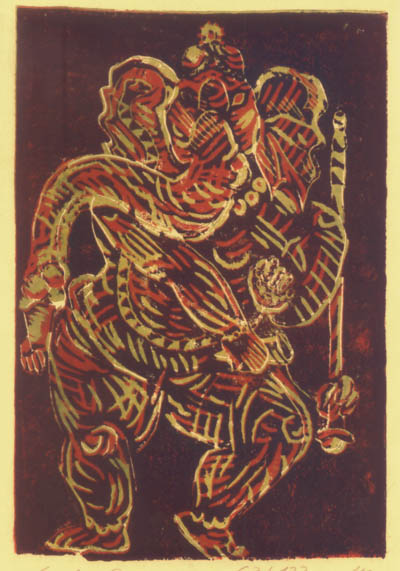
The Gaṇeśa Upaniṣad is one of the central texts of the Gāṇapatya Sampradāya, the groups of devotees for whom Gaṇeśa was the supreme divinity. These groups are thought to have arisen from the 10th century onwards, although there has been comparatively little written about them by contemporary scholars. The Gaṇeśa Upaniṣad belongs to the class of Hindu texts that are considered to be revelatory – śruti – “that which is heard”, and in some quarters, are held to be without ‘origin’. It is a manifestation of a particular ‘Truth’. Like other Upaniṣads, it is not merely to be studied as a written text, but to be spoken – the text not only functions as instructive scripture, but also as a performative liturgy – the act of speaking the Upanishad becomes a revelatory experience. This translation is by the late Mike Magee, and the footnotes are my own.
Continue reading »Another essay from the London Tantra Discussion Group wiki – this time, a reflection on mudras following a retreat the group held in 2002.
Continue reading »I first came across a reference to the goddess Santoshi Ma as a colour postcard in a back issue of Azoth magazine, and was inspired to ‘work’ with her as part of a sadhana using the Empress Tarot card that I later used as the basis of a freeform pathworking at public workshops in the mid-90s. At the time, I assumed that Santoshi was one of the many Hindu devis I had not come across before, and it was only later that I discovered that she was considered by some to be a ‘new’ addition to the company of devis and devas. This essay was originally written in 2005 and is from the defunct London Tantra Discussion Group.
Continue reading »I recently managed to nuke enfolding by trying to upgrade the php to a new version. A nice tech guy at my hosting company (Bluehost) got the site working – phew! Some functionality has been lost, however, such as the “wiki” pages. I did think about creating a new wiki with a paid plugin, but for the moment, I’m just reposting the essays and entries that I think are worth keeping. Of course, multiple links will have to be updated across the site, but that’ll happen over time. In the meantime, here’s The Sugarcane bow, a longish essay from 2011.
Continue reading »