Speaking from Experience
Some reflections on speaking and listening following a discussion at the London Tantra Discussion Group.
Continue reading »Skip to navigation | Skip to content
Some reflections on speaking and listening following a discussion at the London Tantra Discussion Group.
Continue reading »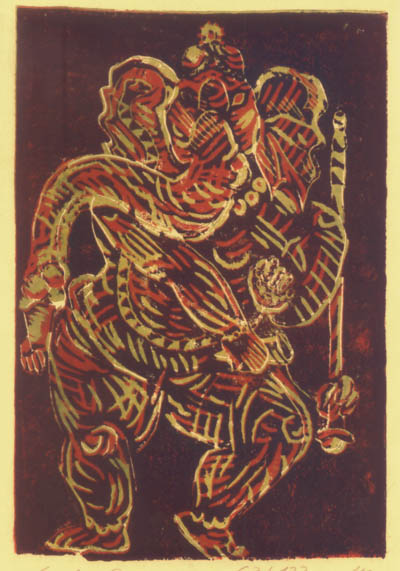
The Gaṇeśa Upaniṣad is one of the central texts of the Gāṇapatya Sampradāya, the groups of devotees for whom Gaṇeśa was the supreme divinity. These groups are thought to have arisen from the 10th century onwards, although there has been comparatively little written about them by contemporary scholars. The Gaṇeśa Upaniṣad belongs to the class of Hindu texts that are considered to be revelatory – śruti – “that which is heard”, and in some quarters, are held to be without ‘origin’. It is a manifestation of a particular ‘Truth’. Like other Upaniṣads, it is not merely to be studied as a written text, but to be spoken – the text not only functions as instructive scripture, but also as a performative liturgy – the act of speaking the Upanishad becomes a revelatory experience. This translation is by the late Mike Magee, and the footnotes are my own.
Continue reading »Another essay from the London Tantra Discussion Group wiki – this time, a reflection on mudras following a retreat the group held in 2002.
Continue reading »I first came across a reference to the goddess Santoshi Ma as a colour postcard in a back issue of Azoth magazine, and was inspired to ‘work’ with her as part of a sadhana using the Empress Tarot card that I later used as the basis of a freeform pathworking at public workshops in the mid-90s. At the time, I assumed that Santoshi was one of the many Hindu devis I had not come across before, and it was only later that I discovered that she was considered by some to be a ‘new’ addition to the company of devis and devas. This essay was originally written in 2005 and is from the defunct London Tantra Discussion Group.
Continue reading »One thing that continues to fascinate me is people that have been influential in their own time but have dropped off the radar since and received comparatively little attention since. When a friend alerted me to Jon Chapple’s biography of Sri Krishna Prem, I knew this would be a fascinating read. An Englishman, born Ronald Henry Nixon, who served in the Royal Flying Corps in the First World War. After the war, he became Professor of English at Lucknow and Banares Universities; and in his final incarnation, as it were, became Sri Krishna Prem – a Vaiṣṇava spiritual leader who attracted both Indian and western followers, including counter-cultural figures such as Timothy Leary and Ram Dass.
Continue reading »I recently managed to nuke enfolding by trying to upgrade the php to a new version. A nice tech guy at my hosting company (Bluehost) got the site working – phew! Some functionality has been lost, however, such as the “wiki” pages. I did think about creating a new wiki with a paid plugin, but for the moment, I’m just reposting the essays and entries that I think are worth keeping. Of course, multiple links will have to be updated across the site, but that’ll happen over time. In the meantime, here’s The Sugarcane bow, a longish essay from 2011.
Continue reading »In the previous post in this series, I briefly examined the North American “panic” over Dungeons & Dragons and other FRPGs that began in 1979. Now I’ll move to the case that triggered the main “Satanic Panic” – the McMartin Preschool case.
Continue reading »In the previous post in this series I examined some of the factors that contributed to the North American Satanic Panic of the 1980s. Now, I’ll take a look at the Dungeons & Dragons “Panic”.
Continue reading »A major theme in Delinquent Elementals, edited by me and Rodney Orpheus, is the British Satanic Panic of 1988-1992. For this series of posts, I’m going to examine the background to the “Panic” and various contributing factors. For the first few posts, I’ll concentrate on the North American Satanic Panic that preceded and influenced the British phenomena.
Continue reading »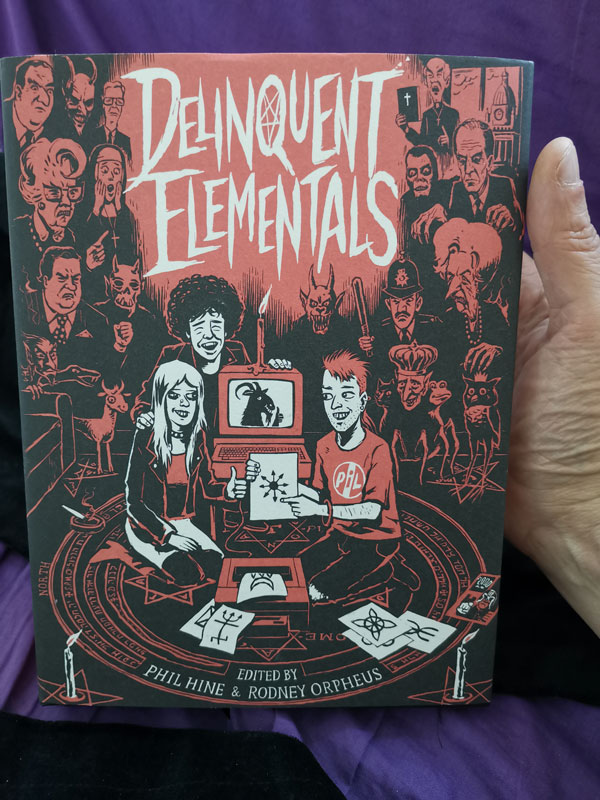
If there’s one thing I’d like to be remembered for, it is Pagan News, the zine that occupied a central place in my life between 1988-92. Delinquent Elementals, edited by myself and Rodney Orpheus (my co-creator and co-editor), brings together a selection of the best content from Pagan News over the 36 or so issues. Six years in production, Delinquent Elementals features a selection of news stories, essays, interviews, tips on practical magic, and more. It is a fascinating window into the UK’s blossoming occult scene at a time of rapid social and political change.
Looking back, I can only wonder how we did it. Of course, there were those at the time, that said we’d never keep to a monthly publishing schedule – producing a zine every three weeks. We developed a system – one zine on the street, one in production, and several in various stages of planning. There was a quiet satisfaction to be had in telling a potential contributor that the slot their submission would be published in was already full for the next three issues.
Delinquent Elementals is available direct from Strange Attractor, or all good bookshops.
