Gaṇeśa Upaniṣad
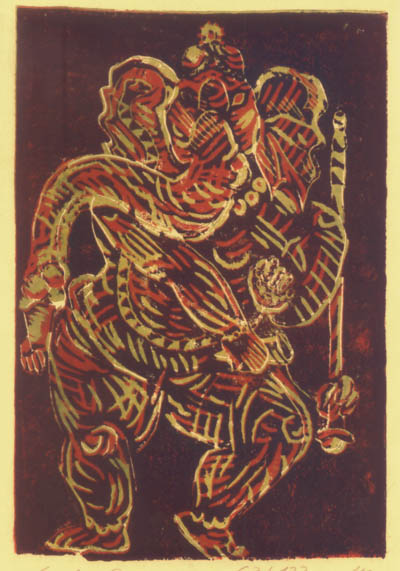
The Gaṇeśa Upaniṣad is one of the central texts of the Gāṇapatya Sampradāya, the groups of devotees for whom Gaṇeśa was the supreme divinity. These groups are thought to have arisen from the 10th century onwards, although there has been comparatively little written about them by contemporary scholars. The Gaṇeśa Upaniṣad belongs to the class of Hindu texts that are considered to be revelatory – śruti – “that which is heard”, and in some quarters, are held to be without ‘origin’. It is a manifestation of a particular ‘Truth’. Like other Upaniṣads, it is not merely to be studied as a written text, but to be spoken – the text not only functions as instructive scripture, but also as a performative liturgy – the act of speaking the Upanishad becomes a revelatory experience. This translation is by the late Mike Magee, and the footnotes are my own.
Om Lam I bow to Ganesha1
You are clearly the Tattva. You alone are the Creator. You alone are the Maintainer. You alone are the Destroyer. Of all this you are certainly Brahma.2
You plainly are the essence.
Always I speak amrita. The Truth I speak.3
Protect me. Protect the speakers. Protect the hearers. Protect the givers. Protect the holders. Protect the disciple that repeats. Protect that in the East. Protect that in the South. Protect that in the West. Protect that in the North. Protect that above. Protect that below. Everywhere protect. Protect me everywhere!
You are Speech. You are Consciousness. You are Bliss. You are Brahma. You are Being-Consciousness-Bliss. You are the Non-Dual. You are plainly Brahma. You are Knowledge. You are Intelligence.4
You create this world. You maintain this world. All this world is seen in you. You are Earth, water, Fire, Air, Space. You are beyond the four measures of speech. You are beyond the Three Gunas. You are beyond the three bodies. You are beyond the three times.5
You are always situated in the Muladhara.6
You are the being of the three Shaktis.7
You are always meditated upon by Yogins. You are Brahma, you are Vishnu, you are Rudra, You are Agni, You are Vayu, You are the Moon, You are the Sun, You are Brahma. Bhur-Bhuvah-Svar.8
‘Ga’ the first syllable, after that the first letter, beyond that ‘m’, then the half-moon all together. Joined with “Om” this is the mantra-form. Letter Ga the first form, letter a the middle form, m the last form. Bindu the higher form, Nada the joining together, Samhita the junction. This is the Vidya of Lord Ganesha.9
Ganaka is the seer, Nricad-Gayatri the metre, Sri Mahaganapati the God. “Om Ganapataye Namah.”10
Let us think of the one-toothed, let us meditate on the crooked trunk, may that tusk direct us.
One tusk, four arms, carrying noose and goad, with His hands dispelling fear and granting boons, with a mouse as his banner.
Red, with a big belly, with ears like winnowing baskets, wearing red, with limbs smeared in red scent, truly worshipped with red flowers.
To the devoted a merciful Deva, the Maker of the World, the Prime Cause, who at the beginning of creation was greater than gods and men.11
He who always meditates thus is a Yogin above Yogins.
Hail to the Lord of Vows, hail to Ganapati, hail to the First Lord, hail unto you, to the Big-Bellied, One-tusked, Obstacle-destroyer, the Son of Shiva, to the Boon-Giver, Hail, hail.12
He who studies this Atharva Shira moves towards Brahma. He is always blissful. He is not bound by any obstacles. He is liberated from the five greater and the five lesser sins. Evening meditation destroys the unmeritorious actions of the night. At both evening and morning he is liberated from the bad and he attains Dharma-Artha -Kama and Moksha.13
He who wants something may accomplish it by 1000 recitations of this. He who sprinkles Ganapati with this becomes eloquent. He who recites this on a 4th day becomes a knower of Vidya. This an Artharva saying “He who moves towards Brahma Vidya is never afraid.” He who worships with fried grains becomes famous and becomes intelligent. He who worships with sweet-meat (modaka) gains the desired fruit. He who worships with samit and ghee by him all is attained, all is gained by him. He who makes eight Brahmanas understand this becomes like the sun’s rays. In a solar eclipse, in a great river, or in front of an image having recited this he gets accomplished in the mantra. He becomes liberated from great obstacles. He is freed from great misfortunes.14
Further Reading
Gudrun Buhnemann. 2008. Tantric Forms of Ganesa. D.K. Print World Ltd.
John A. Grimes. 1995. Ganapati: Song of the Self. State University of New York Press.
Sir John Woodroffe. 2001. The Garland of Letters. Ganesh & Co.
Footnotes
- “Om” (AUM) is the primordial word of creation, itself signifying the absolute – it can mean “I accept”, or “I assent”. All devotional acts begin with the chanting of “Om”. Om serves to focus the attention of the Divine towards the devotee, and the attention of the devotee towards divinity. It is further held by some commentators, that Gaṇeśa is the personification of the primal Om. “Lam” is the bija mantra of the Earth element.
- Gaṇeśa is praised as the Tattva. This term can be translated as “principle” – so Gaṇeśa could here be identified as the ‘Eternal Principle’ underlying reality.
Further, Gaṇeśa is identified as the personification of Trimurti – the Creator (Brahma), the Maintainer (Viṣṇu), and the destroyer (Śiva). As Brahma, he continually creates; as Viṣṇu he holds those creations together in equilibrium; as Śiva he breaks down those combinations of matter. Furthermore, Gaṇeśa is identified as the Absolute (Brahma), and the eternal indwelling “essence” – the Atman (Self). - The speaker asserts that he speaks “Truth” which to him is experiential – from his heart, rather than just parroting or reciting lines. Further, “Amrita” literally means “imperishable” – i.e. that this is an imperishable truth.
- Being (Sat) – Consciousness (Chit) – Bliss (Ānandā) – Saccidānanda – the three aspects of existence. This denotes the Supreme Power. Gaṇeśa is further identified as the “Non-Dual” – Brahma dwells within him. Here is an indication that Gaṇeśa can lead his devotee towards that experience of bliss that is realization of one’s inner divinity. Dissolving the difference between devotee and deity is the object of puja.
- Here, Gaṇeśa is also identified as both finite and infinite: as the 5 elements; as the embodiment of the 4 stages of speech (para, pasyanti, madhyama, vaikhari); as the three Gunas (Rajas, Sattva and Tamas); as the three bodies (physical, subtle, causal); as the three times (past, present, future). Moreover, Gaṇeśa is beyond these finite forms.
- In some chakra schemas, Gaṇeśa is the presiding deity of the Muladhara.
- Gaṇeśa is here related to the three Śaktis (powers) of desire (ichha), Knowledge (jnana), and Action (kriya), possibly in the sense of being the causal agency behind the inter-relation of these three powers, or the embodiment thereof.
- Again, Gaṇeśa is identified as Trimurti. Rudra is a primordial aspect of Śiva. As Agni he is fire; as Vayu, the wind. He is the Moon (Candra); the Sun (Surya); Space (Brahma). The final utterance is formed from the ritual utterances “To Earth” (Bhur), “To Space” (Bhuvas), “To Sky” (Svar).
- These verses present the mantra of Gaṇeśa. The Seed (Bija) sound for Gaṇeśa is “gam”. The Varada-Tantra, Chpt. 6 says: “Ga, I speak unto Thee, means Ganesa. Bindu means Dispeller of sorrow. Thus, O Mahesvari, the meaning of Gam-bija is spoken to Thee out of love for Thee.” These verses are telling the devotee how to proceed with the worship of Gaṇeśa, giving the correct use of the Bija-Mantra: Gam is uttered, prefixed with “Om”. The Bindu is the essence (i.e. higher form) of all sounds. The Nada (Cosmic Sound) is the utterance [of the mantra] – John Grimes adds that “the sounding of it is its enjoyment” (Ganapati, p27) – at the moment I would posit that “joining together” refers to the unification of deity and devotee through the recitation of the seed-mantra, which is the essence thought-form of the god. As for Samhita – it is usually translated as “scripture”, so I take the phrase “Samhita the junction” as a reference to union with the god through the study/meditation of the holy scripture. All this is the wisdom (Vidya) of Lord Ganesha. Note: I tend to equate Vidya with Gnosis in the sense of being knowledge or wisdom gained via revelation. Woodroffe, in The Garland of Letters, says that Śakti moves from Nada to Bindu. Nada is the maithuna (congress) or yoga of Śiva-Śakti, which in turn produces the bindu, which again differentiates into threefold aspects, although in denser form.) According to Woodroffe, the terms Bindu and Nada represent two particular stages in the process of the manifestation of Śakti. Bindu is generally understood as meaning a ‘point’. “Nada” is etymologically derived from ‘sound’.
- The first perception of a mantra is held to arise from a human-divine contact of some kind; hence the first person to utter the mantra is known as its Seer (Sage). In the case of “Gam”, the Upaniṣad says that “Ganaka is the seer”. “Gayatri” is a particular form of mantra, which may consist of a meter, or rhythm that has three stanzas consisting of eight syllables each. A Gayatri mantra is also Devi – the power which one invokes. Whilst mantra alone relies on the Śakti (power inherent in sound) for its effectiveness, a Gayatri mantra is both mantra and prayer. Gāṇapati is the divinity of the mantra – “Om, salutations to the Lord of the multitudes.”
- These verses give the general form (rupa) of Gaṇeśa for worship and meditation.
- This verse is a restatement of some of the epithets used to praise Gaṇeśa. Ekadantā – One-tusked; Lambodara – Big-bellied; Varāḍaya – Bestower of Boons; Sarvatanaya – Son of Śiva; Vighnavināśana – Destroyer of Obstacles.
- According to John Grimes, the phrase “Atharva Shira” suggests “firmness or single-pointedness of the intellect as directed towards one’s realization of the Divine.” (See <i>Ganapati</i>, p22). Thus, we are told that study of this text leads one to realization of the Divine. Dharma, Artha, Kama, and Moksha are the four legitimate life-goals: Dharma can be translated as ‘righteousness’ or ‘duty’; Artha as prosperity; Kama, pleasure, and Moksha, as liberation.
- Note that “1000 recitations” does not necessarily indicate that the text be recited 1000 times as an exact count. Modaka is the sweet flour or rice balls traditionally favoured by Gaṇeśa and offered to him by devotees. In some myths it is said to have similar qualities to the divine Soma. These verses declaim the spiritual benefits from regular study and repetition of the text.
