In the early part of the nineteenth century, electricity was thought to be the force most likely to prove the existence of the elan vitale or life force of Naturalphilosophie. Schelling, at the turn of the century, for example, proposed that heat, light, magnetism and electricity were all byproducts of a single universal life force. The arising of electrical models allowed polarities to be discovered within organisms – and between discrete classes of persons. Thus maleness or masculinity was assigned to the positive pole, and femininity to the negative. The gendering of electricity and energy continued in the nineteenth century, particularly in respect to medical theories and the notion of “nervous energy”, and the rise in popularity of Spiritualism. Continue reading »
Hail to the Lord of Vows, hail to Ganapati, hail to the First Lord, hail unto you, to the Big-Bellied, One-tusked, Obstacle-destroyer, the Son of Shiva, to the Boon-Giver, Hail, hail.
Ganesa Upanisad
Inspired after a recent Ganesa Puja in Wales, and reflecting on the fact that I have been a devotee of Ganapati for well over 20 years now, I thought it would be appropriate to write a short series of posts on some of the more obscure aspects of this much-beloved devata. Continue reading »
Through the process of knowledge assemblage we have created a naturalised space amenable to being mapped; we now equate scientific knowledge with maps.
David Turnbull, Masons, Tricksters and Cartographers
Continue reading »
In our recent trip to Berlin, we happened across a wonderful exhibition at the Museen Dahlem – Vodou: Art and Cult from Haiti – which is on until 24th October 2010. If you should find yourself in Berlin, it’s well worth a look. Continue reading »
“At one extreme experience (present) is offered as the necessary (immediate and authentic) ground for all (subsequent) reasoning and analysis. At the other extreme, experience . . . is seen as the product of social conditions or of systems of belief or of fundamental systems of perception, and thus not as material for truths but as evidence of conditions of systems which by definition it cannot itself explain.” Raymond Williams, Keywords
Continue reading »
A couple of years ago, prompted by a footnote in Logomancy of Zos to the effect that Austin Osman Spare was one of the witnesses for the defence at the trial of Radclyffe Hall’s The Well of Loneliness (1928) I became interested in attempting to trace this connection. Continue reading »
“…persons – single actors – are not thought in South Asia to be “individual,” that is, indivisible, bounded units, as they are in much of Western social and psychological theory as well as in common sense. Instead, it appears that persons are generally thought by South Asians to be “dividual” or divisible. To exist, dividual persons absorb heterogeneous material influences. They must also give out from themselves particles of their own coded substances – essences, residues, or other active influences – that may then reproduce in others something of the nature of the persons in whom they have originated.” McKim Marriott Hindu Transactions: Diversity without Dualism
Continue reading »
We did the ritual at the stump of Jenny’s cherry tree, and afterwards walked in silence down to the beach. Continue reading »
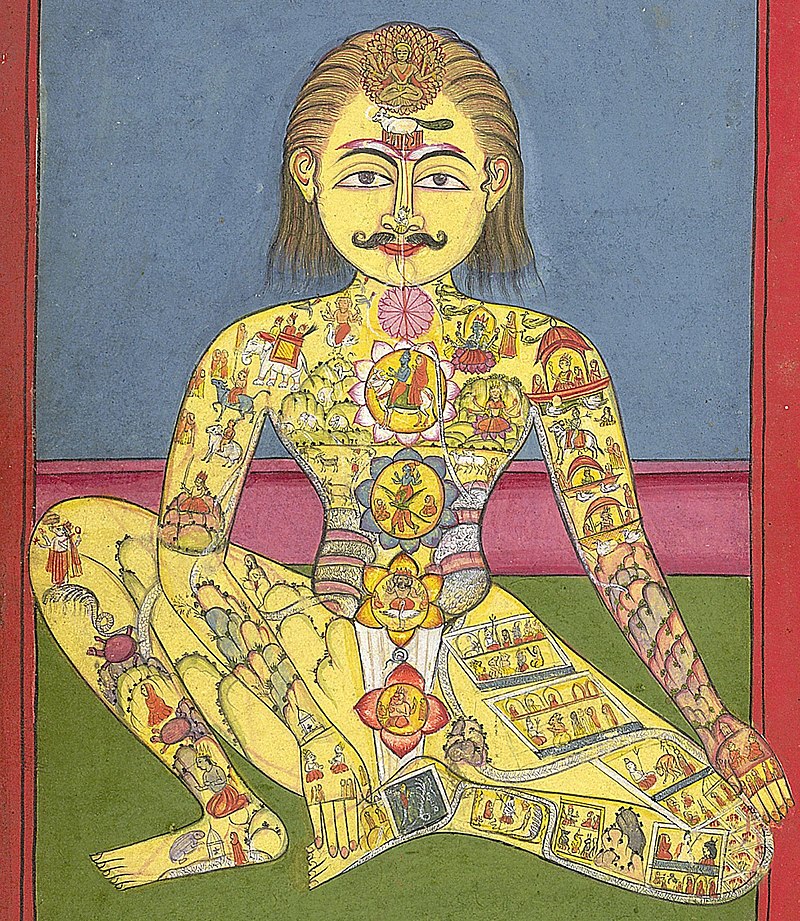
The Tantrists do not seem to go higher than the six visible and known plexuses, with each of which they connect the tattvas; and the great stress they place on the chief of these, the Muladhara Chakra (the sacral plexus) shows the material and selfish bent of their efforts towards the acquisition of powers.The Mahatma Letters (Letter CXIV, p480)
In the last post I reviewed how the notion of the “left-hand path” and much of the themes which relate to it emerged out of nineteenth century Indology. I will now turn to how the concept of the left-hand path” was used by Madame Blavatsky and other early Theosophists. Continue reading »
In popular occult discourse, the concept of the “Left-hand Path” is often stated as originating within the tantric traditions, and sometimes, its popularisation within western occultism is laid at the door of Madame Blavatsky and other popular Theosophical pundits of the late nineteenth century – to the extent that the conceptualisation of the idea of the LHP in wholly negative terms (as can be seen in the writings of successive western occultists – Dion Fortune for example) is something that begins with Madame Blavatsky. However, although she may have been one of the first occultists to write extensively about the Left Hand Path, its identification with moral (and spiritual) degeneracy certainly did not begin with Blavatsky. Continue reading »